
Hit enter to search or ESC to close
Selecting the correct fastening system for plumbing and electrical infrastructure is often a decision based on long-term structural integrity rather than immediate cost. In industrial and residential construction, the failure of a single conduit clip can lead to systemic instability, making the specifications of the underlying fasteners a critical point of failure.
The shift toward more demanding architectural requirements has placed a spotlight on the metallurgical properties of construction nails. Specifically, the need for higher corrosion resistance in humid environments and increased load-bearing capacity in commercial frameworks has moved the industry away from generic fasteners toward engineered solutions.
For procurement managers and contractors, sourcing wholesale construction nails requires an understanding of how material grades and surface treatments impact the project lifecycle. This analysis examines the technical requirements for pipe clip fastening and the operational advantages of precision-engineered steel components.


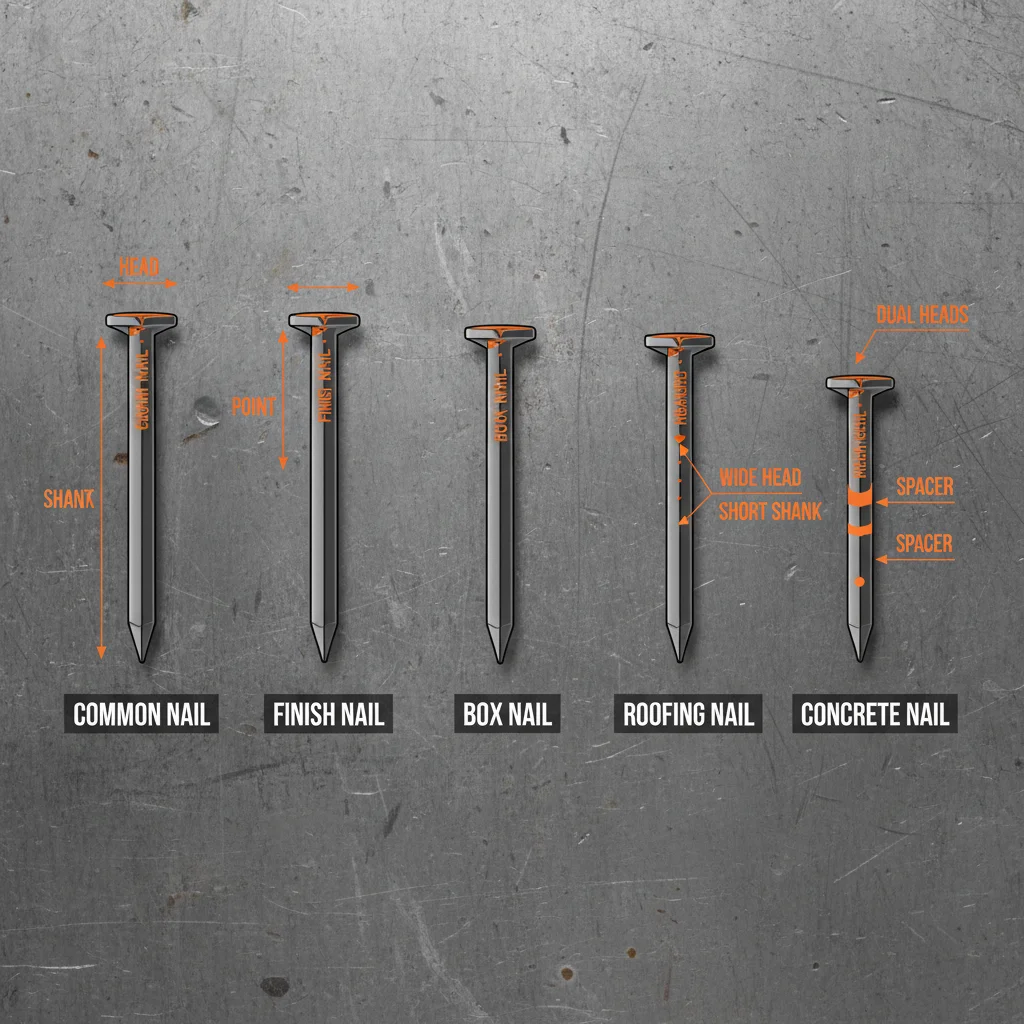
The primary function of a pipe clip nail is to provide a permanent, vibration-resistant anchor for conduits. Unlike general-purpose nails, these require a specific head geometry—typically a flat round head—to prevent the nail from pulling through the clip under the weight of fluid-filled pipes or heavy electrical cabling.
From a mechanical perspective, the interaction between the nail's shank and the substrate determines the installation speed and the final holding power. A smooth shank is preferred in these applications to reduce friction during driving, which minimizes the risk of splitting the substrate and accelerates the overall fixing process on-site.
The load-bearing capacity of a fastener is directly tied to its steel grade. For high-demand plumbing and industrial projects, Class 6 steel is often specified due to its superior balance of hardness and ductility. This prevents the nails from bending during high-force installation while ensuring they do not become brittle and snap under thermal expansion or contraction of the pipes they secure.
Consistency in metallurgical composition is what separates industrial-grade fasteners from consumer-grade options. In bulk procurement, the variance in steel quality can lead to inconsistent penetration depths and unreliable grip, which increases the risk of clip detachment over time. Rigorous adherence to material standards ensures that every unit in a shipment performs identically.
When analyzing structural integrity, the focal point is the shear strength. Fasteners like the Sotts series utilize high-quality steel to maximize this strength, ensuring that the conduit remains flush against the wall even when subjected to the lateral stresses common in commercial building environments.
Corrosion is the primary enemy of metal fasteners in construction, particularly in plumbing where moisture is constant. A specialized galvanized finish acts as a sacrificial anode, protecting the underlying steel from oxidation. This chemical barrier is essential for any installation located in basements, outdoor conduits, or industrial plants where atmospheric humidity is high.
The integration of advanced galvanization and Class 6 steel transforms a simple fastener into a long-term infrastructure asset, significantly reducing the frequency of maintenance cycles and the cost of corrective repairs.
Beyond simple rust prevention, a polished galvanized finish reduces the chemical reactivity of the nail with the surrounding building materials. This ensures that the fastener does not cause staining on architectural surfaces and maintains its structural bond with the substrate throughout the entire lifecycle of the building.
The economic impact of fastener selection is most visible in labor costs. A nail designed for "effortless penetration" reduces the physical force required per unit, which, when scaled across thousands of installations in a large-scale project, leads to a measurable increase in installation speed.
Precision sizing—such as the availability of 4cents, 6cents, and 1inch options—allows contractors to match the fastener exactly to the clip thickness and substrate depth. This eliminates material waste and prevents the "over-driving" of nails, which can damage internal wall structures.
In a typical residential construction setting, 6cents pipe clip nails are the standard for securing internal water pipes. The priority here is a flush fit that doesn't interfere with subsequent drywall installation. The flat round head ensures the clip is held firmly without protruding, allowing for a clean architectural finish.
For industrial infrastructure projects, such as electrical conduit runs in warehouses, the 1-inch variant is often employed to penetrate deeper into heavy-duty substrates. In these environments, the galvanized finish is non-negotiable, as these areas often face temperature fluctuations and chemical exposure that would rapidly degrade untreated steel.
The hardware industry is moving toward "precision fastening," where the focus is shifting from bulk quantity to specific performance metrics. We are seeing an increased demand for fasteners that are not only strong but are designed for specific substrate-clip combinations to minimize installation error.
Sustainability is also becoming a driver. By utilizing higher-grade steels like Class 6 and superior galvanization, the lifespan of the installation is extended. This reduces the need for replacement and the associated material waste, aligning construction practices with broader environmental goals.
Furthermore, the integration of real-time inventory control and streamlined procurement—starting with low MOQs—is allowing contractors to maintain leaner on-site stock without risking project delays. This shift toward agile procurement is redefining the relationship between manufacturers and end-users.
When evaluating options for wholesale construction nails, procurement officers must look beyond the per-unit price. The true cost of a fastener is calculated by its "Installed Cost," which includes labor time and the projected maintenance cost over ten years.
A lower-cost, non-galvanized nail may save money during the purchase phase but can lead to expensive failures in the operational phase. Comparing the relative suitability of different nail types based on the specific environment—residential vs. industrial—is the only way to ensure a high return on investment.
The following framework provides a relative assessment of standard nails versus precision-engineered options like the Sotts series, focusing on long-term project viability.
| Evaluation Factor | Standard Nails | Engineered Nails (Sotts) | Project Impact |
|---|---|---|---|
| Corrosion Life | Short-term | Long-term (Galvanized) | Lower Maintenance |
| Installation Speed | Average | High (Smooth Shank) | Reduced Labor Cost |
| Holding Power | Variable | High (Class 6 Steel) | Increased Safety |
| Material Waste | Moderate | Low (Precision Fit) | Material Saving |
| Substrate Fit | Generic | Precision (4c/6c/1") | Higher Accuracy |
| Overall ROI | Low/Standard | High (Extended Life) | Project Stability |
The primary factor is the surface treatment. For outdoor use, a high-quality galvanized finish is essential as it creates a protective zinc layer that prevents moisture and oxygen from reaching the steel core. This inhibits rust and oxidation, which is critical because outdoor installations are exposed to weathering that would cause standard steel nails to fail rapidly.
The choice depends on the thickness of the clip and the density of the substrate. For standard residential conduits and thin clips, 6cents is generally recommended. 4cents is used for lightweight, shallow applications, while 1-inch nails are required for heavy-duty industrial clips or when the fastener must penetrate through secondary layers of material to reach a structural stud.
No, it does not. While a smooth shank reduces friction during the driving process (making installation faster), the actual holding power is derived from the tight fit between the nail diameter and the substrate, as well as the stability provided by the flat round head. The use of Class 6 steel further ensures that the nail maintains its grip without bending.
Minimum Order Quantities vary by manufacturer, but flexible suppliers now offer MOQs as low as one carton. This allows small-scale contractors to access industrial-grade materials without overstocking, while large distributors can order in bulk for large-scale infrastructure projects. Flexibility in MOQ is a key indicator of a manufacturer's supply chain efficiency.
Yes. The flat round head is specifically engineered to provide a wide contact area. This prevents the nail from pulling through the softer material of plastic clips, making them compatible with both standard metal and most industrial-grade plastic conduit management systems used in modern construction.
Class 6 steel offers a specific mechanical profile that balances tensile strength and flexibility. Standard carbon steel can be too soft (leading to bending) or too hard (leading to snapping). Class 6 ensures that the nail can withstand the force of a pneumatic or manual hammer while remaining rigid enough to support the long-term load of piping systems.
The stability of any plumbing or electrical system is only as reliable as the fasteners that hold it in place. By prioritizing metallurgical quality, such as Class 6 steel, and protective finishes like galvanization, project managers can ensure that their infrastructure remains secure for decades rather than years.
Ultimately, the transition to precision-engineered solutions like those provided by Hebei Lianshi Furniture Hardware Co., Ltd. represents a broader industry move toward efficiency and reliability. Choosing the right specification today prevents the costly failures of tomorrow.

JOIN OUR NEWSLETTER